Writing a Version of Our Younger Selves with Detachment: How Confession Becomes Narrative
LIFE WRITING@ WORDHOUSE

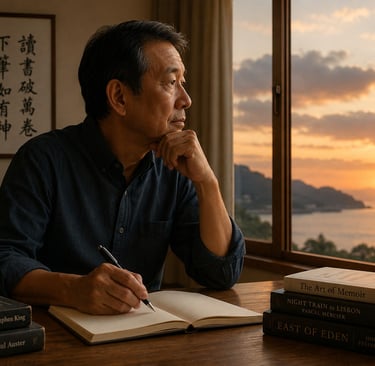
Seeing Our Younger Selves Without Living it All Back
To write our younger selves is to see them clearly, without trying to recover our youth. We are not returning to them. We are simply writing with distance, observing those figures in time rather than living back into their lives.
When we begin writing about our lives, it is easy for us to slip into confession. The “I” becomes immediate, emotional, and it can feel as if everything is happening again while we write. When this happens, our younger selves are no longer something we are describing. They become something we are re-entering. And instead of shaping a story, we end up repeating an experience on the page.
Why Memory Feels So Present When We Write
Our memories are not neutral. The feeling they carry can feel more alive than the present moment when we begin to write. This is why writing is complicated for us. We may try to follow memory in order, trying to remember exactly what happened, exactly how it looked, exactly what was said.
But writing is not the same as replaying life. To turn memory into writing, we have to take what we feel and reshape it into scenes, images, and moments. We are not copying life as it was. We are reconstructing it in language. Our younger selves did not have the words we now carry. When we write, we are not only reporting the past, we are giving it form from where we now stand.
Writing Is Not Merely Remembering
Writing is creative work. It is not only about revealing what we remember, but also about shaping it for clarity and access, for something that can be read, followed, and understood.
This is why writing cannot stay only as confession. If everything is poured out exactly as it is felt, then it is not yet a story. A story needs shape. It needs movement.
This is where detachment becomes important when we write about ourselves. Detachment does not mean we stop feeling. It simply means we allow ourselves enough space to see clearly. That space, between the ones who lived and the ones who are writing, is where narrative begins.
Some Creative Ways Writers Use Detachment from Themselves
In these non-fiction examples, we can see ways in which writers detach from the self.
In The Year of Magical Thinking, Joan Didion reflects on how perception shifts under emotional pressure:
“We are not idealized wild things. We are imperfect mortal beings, aware of that mortality even as we push it away, failingly, corrupted by that awareness. We are not meant to understand it all at once.” Didion is not only remembering, but also observing how remembering works. Both feeling and distance are reflected at the same time. It is not only “I felt,” but also “I noticed what I was becoming in that moment.”In The Liars’ Club, Mary Karr allows the scene to carry the weight without interpretation.
“The smell of that room—faintly sour, like old milk—still comes back to me sometimes when I least expect it. I can be standing in a perfectly ordinary place, and suddenly I am there again, small and watching.” Karr’s re-entry into place and sensation is slowly followed by meaning, but the meaning is not imposed on the reader. She does not explain the memory, but lets it appear as a lived scene.In Men We Reaped, Jesmyn Ward grounds memory in the environment:
“I remember the heat more than anything else, the way it pressed against the windows and made the air inside feel thick and tired. It seemed like even the house was waiting for something to change, though nothing ever did.”In This Boy’s Life, Tobias Wolff writes:
“I didn’t understand then what I understand now: that I was always trying to become someone I could live with. I thought I was escaping, but I was only moving from one version of myself to another.” A natural distance is reflected in this kind of writing. The younger self is not rejected, but revisited by the older self seeing the younger one anew.In The White Album, Joan Didion allows meaning to remain layered and fragmented:
“We tell ourselves stories in order to live. The princess is caged in the consulate. The man with the candy will lead the children into the sea. I recall the desire I felt then to be very far away from the people I was with.”
Writing Prompts to Write Our Younger Selves with Detachment
Write about a younger version of yourself in the third person, describing someone you once knew well. Describe what this younger self was trying to become.
Write a memory by starting only with the place: focus on sights, sounds, temperature, and movement. Return to the same place and write what usually happened there, without naming the emotion.
Choose one object from your past and describe it in detail without explaining its meaning. Write a scene where that object is present and let it “witness” what is happening.
Write one memory as if you are living inside it, seeing only what your younger self saw. Then rewrite the same memory as your older self, adding what you now understand but did not then.
Write about a moment you remember in two opposing ways. Describe a memory where two emotions existed at the same time (e.g., love and fear, joy and loss).
To write from memory is both a challenge and a gift. The challenge is to resist the pull of becoming the younger self again on the page, to hold enough distance so that memory becomes a story. Since we already have the material of a full life within us, we don’t need to force or invent anything. But writing with detachment is seeing our past more clearly, and letting it speak in its own form, rather than becoming overwhelmed by remembering.